The bleeding was the treatment
Her hair was caught in a laundry-packing machine and took her whole scalp with it. Surgeons had it reconnected within four hours, which was the straightforward half. The flap then began to drown in blood that had no way to leave, and the answer was leeches and about ten litres of transfused blood.
- Specialty
- Plastic and reconstructive microsurgery
- Patient
- Woman, 47, Daegu, November 2017
- Mechanism
- Hair caught in a laundry-packing machine
- Extent
- Whole scalp, forehead, both upper eyelid creases, and into the neck
- Ischaemic time
- About four hours
- Operation
- Both temporal arteries and veins reconnected; a vein taken from her leg to bridge the left side
- The problem after
- Severe venous congestion across the whole flap
- Treatment
- Three to four leeches, four to six times a day, plus heparin injected into the flap
- Blood replaced
- Roughly a litre a day for nine days
- Congestion resolved
- Postoperative day 5
- At three years
- Hair over about 85% of the scalp
- 0 hthe machine takes it
- 4 hvessels reconnected
- day 2the flap turns purple
- days 1-10leeches, and heparin
- 9 daysten litres replaced
- day 5the congestion breaks
- 3 yearshair over 85%
Why it comes off in one piece
She was 47, and her hair was caught in a machine that packs laundry.
Hair does not tear when it is pulled by machinery. It winds, and the force is transmitted into the skin the follicles are anchored in. The scalp then separates along a plane of loose tissue above the skull, which is why these injuries come away as a single sheet rather than in fragments. Hers ran from the bridge of the nose, across the upper tips of both ears, down to the lower occiput, taking her forehead, both upper eyelid creases and part of her neck with it.
What separates this from a clean cut is not the size of the wound but what happens inside the vessels.
A blade divides an artery at a point. Traction tears it along its length, and the damage includes the intima, the smooth inner lining whose entire job is to keep blood from clotting as it passes. Damaged intima does the opposite: it is strongly thrombogenic. So the surgeon is not just reconnecting vessels, but reconnecting vessels that are primed to clot, over a length that is hard to judge by eye.
Before microsurgery existed, the avulsed scalp was simply laid back down and stitched as a graft. It closed the wound and it produced baldness, because follicles do not survive without a blood supply. The first true scalp replantation was performed in 1976.
Four hours, and a vein taken from her leg
Other life-threatening injuries were excluded, the detached scalp was rinsed with saline, and she was in theatre quickly. Total ischaemic time was about four hours.
Under the microscope the surgeons used the superficial temporal arteries and veins on both sides as the points to reconnect to. The arteries were manageable. The scalp is unusually forgiving here: its arteries interconnect so richly that a single restored artery can perfuse a very large area, provided the galea is intact.
The left side was the problem. The left temporal vein was both narrow and short, and pulling it to meet its counterpart would have put the join under tension, which is the reliable way to make a venous anastomosis fail. So they harvested a vein from her right lower leg and used it as a bridge, giving enough length to join the two ends without pulling on either.
That detail matters for what happened later. One side of her head had a straightforward venous connection and the other had a graft.
Drowning in blood
By the second day the flap was severely congested throughout.
The phrase sounds minor and the mechanism is not. Blood was arriving at full arterial pressure and leaving through drainage nowhere near equal to it. The tissue filled, and as it filled the pressure inside it climbed. Once that pressure approaches the pressure inside the capillaries, flow through them stops.
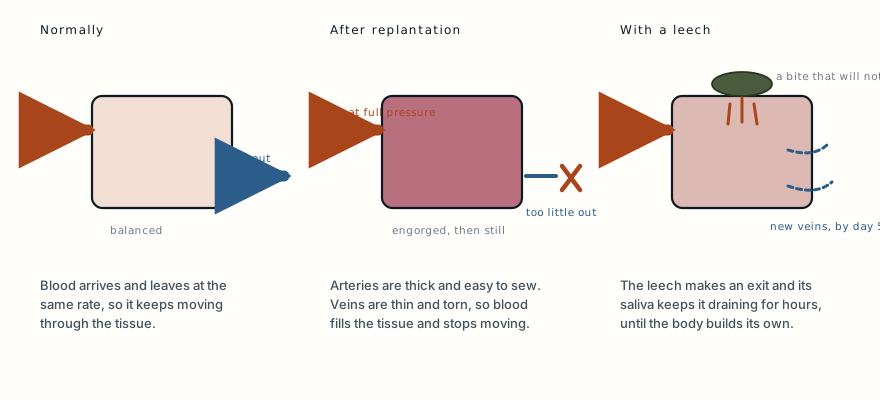
Tissue then dies holding more blood than it has ever held. Congested tissue is dark purple, tense to touch, and bleeds dark blood the instant it is pricked, which is the opposite of tissue with no arterial supply at all: pale, slack, and bleeding nothing.
Elsewhere on this site the rule is that bleeding proves a live blood supply, in a crushed hand and in infected tissue cut back until it bled. This is the case where it runs the other way. Here bleeding was not the sign that things were working. Producing it deliberately was the treatment.
What a leech actually does
The flap needed somewhere for blood to go until it could grow drainage of its own. A medicinal leech provides exactly that, and the mechanism is not the one most people assume.
The volume a leech drinks is trivial. The effect is what happens after it lets go. Leech saliva contains hirudin, among the most effective anticoagulants in nature, along with vasodilators, an anaesthetic so the patient does not feel the bite, and an enzyme that helps the saliva spread through tissue. The bite therefore keeps oozing for hours after the animal has been removed, and that prolonged ooze is the therapy.
She had three to four leeches applied at a time, four to six times a day. The number was reduced as the flap improved, which made the leeches a crude but direct measure of how the drainage was recovering.
Alongside them the team used what the paper calls chemical leech therapy: 2 mg of low-molecular-weight heparin injected under the skin of the flap three times a day, with heparin-soaked saline gauze kept on the surface to stop it crusting over. The aim is the same controlled oozing across the whole flap rather than only where a leech happens to be sitting.
What that costs
Deliberately preventing an entire head from clotting has a consequence that is easy to state and hard to picture.
She was transfused at an average of about 1.1 litres of packed red cells a day, for five days, and then for another four days after the vein graft. That is in the region of ten litres of blood replaced over nine days, in a woman whose total blood volume is roughly four and a half.
The drains tell the same story from the other end: an average of around 900 millilitres a day from the scalp alone, with the first drain collecting 1.6 litres.
She also went back to theatre twice for debridement and washout during this period.
There is a second risk that gets less attention than the bleeding. Medicinal leeches carry Aeromonas in their gut, which is how they digest blood, and that organism can infect the flap it is meant to be saving. Patients on leech therapy are given antibiotic cover against it routinely.
When it turned
The congestion improved on the fifth day after surgery.
That timing is not arbitrary. It takes roughly that long for new vessels to grow across the join and establish drainage the flap can use on its own. The leeches were covering precisely that gap, and by day ten the flap was starting to blanch in patches, which is the visible sign of a tissue that is no longer engorged.
Wound healing was largely complete at two weeks.
What survived, and what did not
Part of the lower left occipital scalp died. That area was debrided and closed with a split skin graft at two weeks, and it is permanently bald.
Hair was visibly growing across the rest at two months, but not evenly. The right temporal area grew back better than the left temporal and occipital regions, which is the same left side that had needed the vein graft. Drainage on that side was reconstructed rather than direct, and the flap there had a harder time.
She had several scar revisions to her neck and eyebrow over the following two years.
At three years, hair covered about 85% of the replanted scalp.
That number is the point of the whole exercise. A skin graft would have closed the wound just as reliably and left her completely bald for the rest of her life, because follicles cannot be transplanted in a graft and do not regenerate. Everything difficult here, including ten days of leeches and ten litres of transfused blood, was in service of keeping follicles alive long enough to start growing again.
What this case teaches
Getting blood into replanted tissue is the part that looks hard and is not. Arteries are thick-walled and hold their shape; veins are thin, collapse, and in an avulsion are torn along their length with the clot-prone inner lining damaged, so after a technically successful replantation blood routinely arrives faster than it can leave. The flap engorges, the pressure inside it rises until capillary flow stops, and the tissue dies holding more blood than it ever has. A leech does not fix that by drinking. It leaves behind a bite that will not clot, draining the flap for hours at a time until the body grows veins of its own, which took five days here. Ten days of that, and about ten litres of transfused blood to pay for it, bought back 85% of her hair.
Adapted from Lee JH, Kim DG, Choi KY, Chung HY and Lee JS, “Successful Microsurgical Replantation of Scalp Amputation Using Medicinal and Chemical Leech Therapy: A Case Report,” Archives of Hand and Microsurgery 2020;25(4):320-325, from the Department of Plastic and Reconstructive Surgery, Kyungpook National University, Daegu. The injury, the operative detail, the leech and heparin protocol, the transfusion and drainage volumes and the three-year outcome are as reported there, summarised in the author’s own words rather than reproduced. The paper gives the leech frequency as six times daily in its abstract and as four to six times daily in the case description; the fuller figure is used here. Background on scalp anatomy, intimal injury in avulsion, the composition of leech saliva and the Aeromonas risk is drawn from standard references. The paper is published under a Creative Commons Attribution Non-Commercial licence, so its clinical photographs are not reproduced here. The diagram is original to MedicaseHub and may be reused freely. This article is not medical advice. Read the full disclaimer.
One case, written up properly, when there is one worth sending
No schedule and no filler. When a case turns out to have something in it that is worth the time to explain, it goes out. Unsubscribe in one click.
Free · no spam · your address is never shared · built with KitRelated cases
- Replanting an arm: the clock, and the harder questionSix hours of viability, and a decision about whether to reattach a limb at all.
- The hand arrived still inside the machineNothing below the wrist bled, and that single finding decided the operation.
- Two flaps, and no microscopeBoth muscles used to rebuild his face stayed joined to their own blood supply.