The window stopped the sunburn, not the damage
For 28 years he drove a delivery truck with the sun coming in through the side window. Over that time one side of his face thickened, furrowed and filled with blackheads, and the other side did not. The glass had filtered out the rays that burn and let through the ones that go deeper.
- Specialty
- Dermatology
- Patient
- Man, 69
- Occupation
- Delivery truck driver for 28 years
- Duration
- 25 years of slow change, on the left side of the face only
- Symptoms
- None. No pain, no itch
- Examination
- Thickened skin with deep ridging, clusters of open comedones, nodules of elastosis
- Biopsy
- Degraded elastic material built up in the dermis; milia forming in fine hair follicles
- Diagnosis
- Favre–Racouchot syndrome, a pattern of chronic sun damage (dermatoheliosis)
- The cause
- Ultraviolet A passing through window glass
- Advice given
- Sun protection, a topical retinoid, regular checks for skin cancer
- 28 yearsbehind the wheel
- 25 yearsone side changes
- age 69what the skin showed
- biopsywhat lay underneath
- the glasswhat a window lets through
- afterthe risk he still carries
A dose delivered to one side
He drove a delivery truck for 28 years.
That is thousands of days spent in the same seat, with the head held in the same position, and the same side of the face a short distance from the same pane of glass. Few exposures in ordinary life are as consistent as that, or as lopsided.
The report does not say which way the truck usually faced the sun, and it does not need to. In a left-hand-drive vehicle the driver's window is on the left, and the left side of his face is the side that changed.
What makes the case useful is that he served as his own control. The two halves of his face shared the same genes, the same age, the same diet and the same habits. The one thing that differed was the window.
Why nobody noticed it happening
He was 69 when he was seen, and he described 25 years of gradual thickening and wrinkling on the left side of his face.
The two figures, 28 years of driving and 25 years of visible change, are not a contradiction. Sun damage of this kind builds up quietly for years before anyone can see it, so the change appearing only some time after the exposure began is what would be expected. The report does not say exactly when in his driving career it started.
It had never hurt or itched. That is a large part of why it went on for a quarter of a century. Sunburn is the body's warning that it has had too much ultraviolet light, and the part of sunlight that does this kind of damage produces very little burn. There was nothing to feel on any given day, only a change too slow to see from one year to the next.
The side window was also doing exactly what people assume windows do. It stopped him burning. That was the reassurance, and it was the trap.
Thick, furrowed, and full of blackheads
Three findings were visible on examination.
The first was hyperkeratosis with accentuated ridging: the outer layer of the skin had thickened, and its normal fine lines had deepened into furrows. The second was a scattering of open comedones, which are blackheads. The third was nodular elastosis, raised, often yellowish lumps made of damaged elastic tissue sitting just beneath the surface.
That combination has a name. Favre–Racouchot syndrome
A pattern of chronic sun damage described by two French dermatologists in the 1930s and 1950s: thickened, yellowish, furrowed skin with clusters of blackheads and small cysts, usually around the eyes and on the cheeks, most often in older men with long outdoor exposure. Smoking is also associated with it.
The blackheads are not acne and do not come from the same process. In sun-damaged skin the tissue around each hair follicle loses the support that normally holds the follicle's opening narrow. The openings widen, fill with keratin, and darken at the surface.
The scaffolding had been replaced
Under the microscope the dermis, the deeper layer of the skin, was full of degraded elastic material. There were also milia, tiny cysts of trapped keratin, forming inside the fine vellus hairs that cover most of the face.
The first finding is known as solar elastosis, and it is the signature of long-term sun damage. Healthy dermis is built mostly from collagen, arranged in organised bundles, with a fine network of elastic fibres that lets skin stretch and return. In chronically exposed skin, much of that organisation is gone. It is replaced by thick, tangled, clumped material that stains like elastin but does none of elastin's work.
That is why this kind of skin behaves the way it does. With nothing organised holding it up, the dermis sags and folds. The outer layer thickens over the top of it, which is part of the skin's response to repeated injury, and the result is skin that is heavier and coarser rather than thinner.
Together the findings fitted dermatoheliosis, the formal term for skin changed by sunlight. The unusual part was only that it stopped at the midline of his face.
Two kinds of ultraviolet, and one of them gets in
The ultraviolet light in sunshine that reaches the ground comes in two bands that matter for skin.
Ultraviolet B has the shorter wavelength. It carries more energy per photon, is absorbed mostly in the outer layer of the skin, and is the main cause of sunburn. Ordinary window glass absorbs almost all of it.
Ultraviolet A has the longer wavelength. It makes up most of the ultraviolet in sunlight, it causes little redness, and much of it passes straight through standard glass. It also penetrates further into the skin, down into the dermis where the collagen and elastic fibres are.
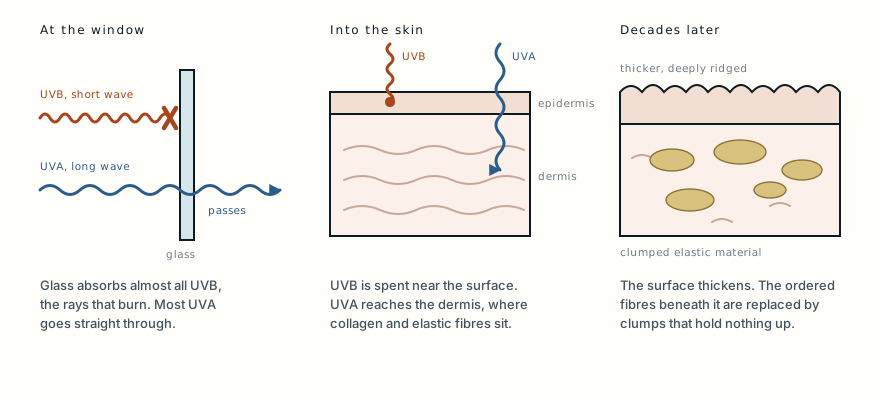
In the dermis, ultraviolet A generates reactive oxygen molecules that damage cells and fibres directly, and it switches on enzymes that break collagen down. Repeated for years, the breakdown outpaces repair, and what is left behind is the disorganised elastic material seen on his biopsy.
Vehicle glass is not all the same. Windscreens are laminated, with a plastic layer between two sheets of glass, and block most ultraviolet A. Side windows are usually a single toughened sheet, and the protection they give varies considerably from one vehicle to another. A driver's face is therefore shielded from the front and exposed from the side, which is the pattern his face recorded.
Ageing and cancer are different injuries
The authors drew a distinction between two things ultraviolet light does to skin. One is photoageing, the structural damage visible on his face. The other is photocarcinogenesis, the mutations that lead to skin cancer.
Ultraviolet B is the stronger driver of skin cancer. That does not make ultraviolet A safe. It damages DNA as well, largely through the same reactive oxygen molecules that break down collagen, and it contributes to the development of skin cancer. The visible damage on his face was a record of the dose, and the dose carries a cancer risk whether or not it ever burned.
He was advised to use sun protection, to apply a topical retinoid, and to have his skin checked for cancer at intervals.
Retinoids are vitamin A derivatives that can partly improve photodamaged skin over months, by encouraging new collagen to be laid down. They do not reverse decades of change. The checks matter more than the cream: they are there to find a skin cancer early on the side of the face that received the exposure.
For sun protection the detail that matters is the band. The SPF number on a sunscreen mainly describes protection against ultraviolet B, the burning rays. Protection against ultraviolet A is labelled separately, as broad-spectrum or with a UVA rating, and it was ultraviolet A that did this.
What the rest of us can take from one face
Most people do not spend 28 years at the same window, and the point of this case is not that a car journey is dangerous.
The point is that glass gives a false sense of protection. Being indoors or in a car stops sunburn, and sunburn is the only signal most people have for how much ultraviolet they have received. Behind glass that signal is switched off while a large share of the exposure continues.
Studies of skin cancer in the United States have reported somewhat more tumours on the left side of the body than the right, a difference usually attributed to time spent driving. The effect across a population is modest. In one man, over 28 years and at a fixed angle to one window, it was visible from across a room.
For people who spend long hours beside a side window, at work or at the wheel, the practical answers are ordinary ones: a broad-spectrum sunscreen on exposed skin, and, where it is permitted, a clear film on the side windows that blocks ultraviolet A.
What this case teaches
Window glass removes the part of sunlight that burns and lets through most of the part that ages. Ultraviolet A causes little redness, so there is no daily warning, and it reaches the dermis, where over years it breaks down collagen and leaves behind clumps of useless elastic material. The outer layer thickens over that damaged scaffolding, the follicle openings widen into blackheads, and the skin becomes heavy, furrowed and coarse. A driver sits with a laminated windscreen in front and a plain side window to one side, and this man's face recorded 28 years of that arrangement down its midline. The same light that aged one side of his face also damages DNA, which is why the most important advice he was given was not the cream but the checks.
Adapted from Gordon JRS and Brieva JC, “Unilateral Dermatoheliosis,” New England Journal of Medicine 2012;366:e25. The presentation, examination, biopsy findings, occupational history and advice given are as reported there, summarised in the author’s own words rather than reproduced. The clinical photograph from that article is held by the journal and is not reproduced here. Background on ultraviolet A and B, their transmission through window and vehicle glass, the mechanism of photoageing, Favre–Racouchot syndrome, retinoid treatment and sunscreen labelling is drawn from standard references. The diagram is original to MedicaseHub, is simplified, and may be reused freely. This article is not medical advice. A new, changing, bleeding or non-healing spot on the skin should be seen by a doctor. Read the full disclaimer.
One case, written up properly, when there is one worth sending
No schedule and no filler. When a case turns out to have something in it that is worth the time to explain, it goes out. Unsubscribe in one click.
Free · no spam · your address is never shared · built with KitRelated cases
- Keloid vs hypertrophic scar: fifteen years untreatedAnother skin change that took years, one slow step at a time.
- A vein that closed at birth, reopened fifty years laterA sign visible on the skin that is really about something deeper.
- He was not going blind from the fireHis eyes survived the burns. His eyelids did not, and nothing grafted can be made to blink.